
Risk Management Structure
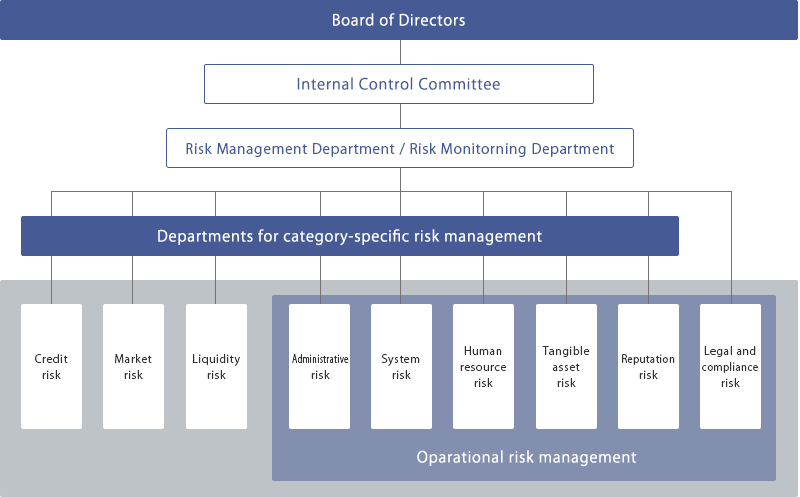
The Company promotes risk management with the aim of comprehensively identifying and assessing various risks faced by the Group by risk category, based on as consistent an approach as possible, and contributing to the achievement of more certain and sustainable business performance.
To promote such risk management, the Company has established a Risk Management Department as the department responsible for overseeing risk management across the Group.
The Risk and Compliance Committee comprehensively examines and deliberates on matters related to overall risk management of the Group and refers necessary matters to the Board of Directors.
The Board of Directors regularly receives reports on the status of risk management, conducts monitoring thereof, and deliberates and determines important fundamental matters relating to risk management.
With respect to Group-wide management risks and the status of their management, evaluations and confirmations are conducted by the Risk and Compliance Committee and reported to the Board of Directors. The Board of Directors oversees overall risk management and conducts regular reviews of the effectiveness of the risk management process. Through this framework, the Company has established a system that enables the practice of risk management that responds promptly and appropriately to changes in the business environment.
The Group classifies risks arising in the course of its operations into “credit risk,” “market risk,” “liquidity risk,” and “operational risk,” based on risk factors, and manages each risk in accordance with its characteristics. In addition, with reference to the COSO framework, the Group conducts risk management under an enterprise-wide risk management structure.
Credit risk management
Credit risk management is primarily related to credit provided to individuals, such as housing loans and credit cards, and therefore these risks are diversified into small lots. Credit risk associated with housing loans is reduced through stringent pre-screening and follow-up monitoring, as well as by securing loans with the associated properties.
Market risk management
Market risk management is carried out by ensuring a mutual check and balance system for business operations through the development of risk management organs and systems that are independent from profit-making departments. Quantitative analysis of risks from financial instruments held is also carried out. Specifically, risk is managed to ensure that the measured risk does not exceed the maximum risk amount resolved at the Board of Directors.
Liquidity risk management
Liquidity risk management involves systems that are developed to respond to the actual cash flow situation at each Group company. Risk is managed with an emphasis on securing liquidity, while also taking the efficiency of funds operations into consideration.
Operational risk management
With respect to operational risk management, the Group classifies operational risks into six categories: administrative risk, system risk, human resource risk, tangible asset risk, reputation risk, and legal and compliance risk. Departments responsible for each risk management manage risks from its position of expertise, whilehe the Risk Management Department identifies and manages operational risk on a comprehensive level.