Climate Change Initiatives
Our Approach to Climate Change (Initiatives Based on TCFD Recommendations)
As a result of increasing natural disasters and extreme weather events caused by climate change, our business operations may be affected due to physical damage to sales offices and communication systems at our Group companies.
The Paris Agreement came into effect in 2016 and the 26th Conference of the Parties to the United Nations Framework Convention on Climate Change (COP26) adopted the Glasgow Climate Agreement in 2021, which pursues efforts to limit global warming to within 1.5℃, compared to pre-industrial levels. As a result of the long-term targets being set, countries have submitted national targets for reducing greenhouse gas emissions to the United Nations and are taking action to achieve them. The government of Japan has also declared carbon neutrality by 2050, aiming to realize a decarbonized society, and is promoting various measures centered on strengthening renewable energy.
The AEON Group has tackled climate change issues that may have a major impact on the global environment and human society from an early stage and declared the AEON Decarbonization Vision which aims to reduce CO2 emissions at stores to zero by 2040.
In November 2021, AEON Financial Service Co., Ltd. (hereinafter "the Company") announced its support for the Task Force on Climate-related Financial Disclosures (TCFD) and clarified its policy on addressing climate change to promote management that contributes to building a sustainable society.

Governance
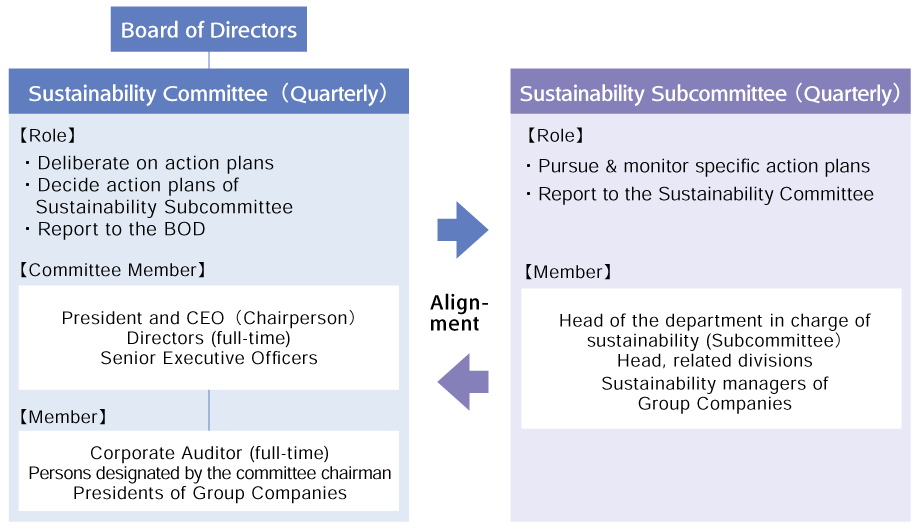
We have established a Sustainability Committee, commissioned by the Board of Directors, with the aim of maximizing corporate value through sustainability-focused management.
The Board of Directors aims to enhance corporate value by prioritizing agility and ensuring prompt, appropriate decision-making. Key sustainability matters including responses to climate change, the determination and revision of the "Basic Sustainability Policy," and the approval of medium- to long-term and annual activity plans, are subject to Board resolutions following deliberation by the Sustainability Committee. The Board provides necessary guidance and advice to relevant parties regarding these key sustainability matters.
The Sustainability Committee exercises governance over the Group’s material issues (materiality) from a societal perspective and determines corporate strategies and policies regarding sustainability. It deliberates on specific goals and implementation plans for various measures and continuously monitors and follows up on (providing guidance and advice for) the Group’s initiatives and their progress. Furthermore, to address issues across the entire organization, the Committee guides various departments and Group companies, oversees and supports the execution of measures, and comprehensively and expertly deliberates on sustainability-related matters. The Committee also reports to the Board of Directors on matters commissioned by the Board.
To drive the implementation of specific goals and action plans as a unified Group, we have established a Sustainability Subcommittee under the Sustainability Committee. We are promoting the effective use of resources through our business activities by transforming our business models and are working toward decarbonization in partnership with customers and local communities through the products and services we provide. Additionally, we are fostering greater environmental awareness and encouraging proactive engagement among every employee within the Group.
Sustainability Execution Framework
Strategy
The Group pursues sustainability management with the aim of realizing a sustainable society in which everyone can live a content and happy life and contribute to peace. In November 2021, we identified material issues that affect our business over the medium to long term. By systematically classifying these into four areas: "pursuing happiness through innovative financial services," "exerting diversity and the potential of our people," "establishing organizational resilience," and "addressing climate change," we set indicators and create a roadmap to specifically take action on them. In particular, recognizing that "addressing climate change" has a significant impact on the lives and health of our customers, local economies, and social development, we expressed our support for the Task Force on Climate-related Financial Disclosures (TCFD) in November 2021, and will strive to ensure resilience through governance, strategy, and setting targets to build a decarbonized society.
First, as part of managing climate change-related risks, we conducted scenario analysis of climate change-related risks and opportunities based on two scenarios, the 1.5℃ scenario and the 4℃ scenario, with the aim of assessing the impact of climate change on the Group's businesses. Specifically, medium to long-term risk items stemming from climate change were organized into transition risks, physical risks and opportunities. Then, the impact of each item on the Group was assessed and those identified to have a significant impact were designated as "serious risk/opportunity items." Each item was then organized in a short-, medium-, and long-term framework according to the time horizon in which it is expected to have an impact.
Significant climate change-related risks/opportunities and their impact levels for the Group identified by scenario
| Classification Level 1 |
Classification Level 2 |
Classification Level 3 |
Impact | Time Horizon | 1.5℃ scenario |
4℃ scenario |
|---|---|---|---|---|---|---|
| Transition Risks |
Policy and Regulation | Introduction of Carbon Tax | Tax increases due to Carbon Tax | Short to long-term | large | medium |
| Market | Rising renewable energy prices | Increased energy costs due to renewable energy procurement | Short to long-term | large | medium | |
| Physical Risks |
Acute | Severe natural disasters such as typhoons and floods | Damage to infrastructure, facilities and equipment Increased costs, increased debt collection risk in business operation regions, increased insurance premiums, and reduced availability of insurance products |
Medium to long-term | medium | large |
| Chronic | Average temperature rise, sea level rise | medium | large | |||
| Opportunities | Energy | Introduction of carbon tax | Reduction of impact of carbon tax introduction by GHG emission reduction (e.g., issuing Aeon Cards using recycled PVC materials, office relocation to energy-efficient buildings) | Short to long-term | large | medium |
| Products and Services | Increased demand for products related to climate change | Increased revenues from new product development and sales (e.g., home loans for decarbonized housing (ZEH) and car loans for electric vehicles (EVs) | Medium to long-term | large | medium |


Risks and Opportunities
■Transition risks
Transition risks refer to risks that impact business operations and financial performance due to changes in climate change policies and regulations, technological developments, market trends, and market valuations. As society transitions to a decarbonized model, changes in laws and regulations, such as the introduction of carbon taxes or preferential measures for renewable energy and electric vehicles, could lead to financial impacts. These impacts include increased tax burdens, surging energy prices, higher credit-related expenses, and rising financing costs. Furthermore, a perceived lack of commitment to sustainability, including climate change initiatives, could result in a loss of market confidence and a decline in corporate value.
■Physical risks
Physical risks refer to risks where disasters or other events caused by climate change have acute or chronic impacts on business operations and assets. Extreme weather events, such as floods, could not only disrupt the lives of customers and employees but also cause direct damage to assets like store facilities. Additionally, there is a risk that maintaining financial infrastructure services, such as credit card and banking systems, could become difficult. This then leads to increased costs for recovery and countermeasures.
■Opportunities
The realization of a decarbonized society is expected to drive greater environmental awareness and create a demand for large-scale business infrastructure and equipment. The Group anticipates expanding business opportunities by offering new, environmentally conscious financial services to customers, including loans and leases for decarbonization-related equipment and housing. We also aim to achieve financial benefits such as cost reductions and increased revenue within our own operations by utilizing renewable energy and switching to low-carbon materials.
Risk Management
The Group is conducting risk management sophistication with the aim of maintaining the soundness of management by evaluating various risks, including climate change, by risk category and appropriately managing them while comparing and contrasting with management strength. In the course of this effort, a series of risk management processes consisting of "risk identification and evaluation," "evaluation of controls," and "risk assessment" were established.
In climate change risk management, we conduct forecasting analysis using multiple scenarios such as the "1.5℃ scenario" and "4℃ scenario" to identify and evaluate climate change-related risks and opportunities affecting the Group. In order to reflect the identified risks and opportunities in the Group's business plan, the scale and scope of the potential impact on business units are evaluated through discussions at the Sustainability Subcommittee, under the direction and supervision of the Sustainability Committee.
Metrics and Targets
The Group measures and ascertains greenhouse gas (GHG) emissions in order to assess and manage climate change-related risks and opportunities. Going forward, we will set targets and indicators to reduce the environmental impact associated with our business activities in order to contribute to the reduction of GHG emissions worldwide.
① Major climate-related indicators in the Group
| Indicators | FY2020 Results | FY2021 Results | FY2022 Results | FY2023 Results | FY2024 Results | FY2025 Results | Change | |
|---|---|---|---|---|---|---|---|---|
| GHG emissions across the Group(Scope1, 2) | 15,828 tons | 16,373 tons | 14,455 tons | 12,059 tons | 10,846 tons | 11,119tons | 273 tons | |
| Ratio of hybrid vehicles to sales vehicles | 49.29% | 43.90% | 53.11% | 34.04% | 54.85% | 54.23% | △0.62% | |
| Credit card statement Web statement ratio | Domestic | 79.00% | 83.97% | 85.12% | 85.92% | 86.62% | 87.50% | 0.87% |
| Global | - | - | 64.69% | 75.39% | 83.57% | 85.83% | 2.25% | |
| Total | 79.00% | 83.97% | 78.48% | 82.08% | 85.58% | 86.87% | 1.29% | |
② Greenhouse gas (GHG) emissions by the Group
(Scope1, 2)
| Item | FY2020 Results | FY2021 Results | FY2022 Results | FY2023 Results | FY2024 Results | FY2025 Results | Change |
|---|---|---|---|---|---|---|---|
| Scope1 (Direct emissions from fuel consumption) | 2,598 tons | 3,332 tons | 2,783 tons | 2,548 tons | 2,642 tons | 2,625 tons | △17 tons |
| Scope2 (Indirect emissions from electricity use) | 13,230 tons | 13,041 tons | 11,672 tons | 10,389 tons | 8,765 tons | 10,613 tons | 1,848tons |
| Scope1 and Scope2 Total | 15,828 tons | 16,373 tons | 14,455 tons | 12,059 tons | 10,846 tons | 11,119tons | 273tons |
(Scope3)
| Item | FY2020 Results | FY2021 Results | FY2022 Results | FY2023 Results | FY2024 Results | FY2025 Results | Change | |
|---|---|---|---|---|---|---|---|---|
| Emissions resulting from credit card paper statements※1 | Domestic | 15,695 tons | 12,037 tons | 11,421 tons | 11,184 tons | 10,776 tons | 10,218 tons | △558 tons |
| Global | ー | ー | 13,043 tons | 11,242tons | 6,818tons | 6,861tons | 44tons | |
| Total | 15,695tons | 12,037tons | 24,464tons | 22,426tons | 17,594tons | 17,079tons | △514tons | |
| Emissions pertaining to printer use (upstream and downstream) | 400tons | 287tons | 370tons | 239tons | 268tons | 185tons | △83tons | |
| Emissions related to the operation and maintenance of data centers ※2 | 4,703 tons | 4,794 tons | 4,534 tons | 4,729tons | 4,550tons | 3,592tons | △959tons | |
| Scope3 Total | 20,798 tons | 17,118 tons | 29,368 tons | 27,394tons | 22,412tons | 20,856tons | △1,556tons | |
・The Group calculates GHG emissions in accordance with the GHG protocol methodology.
※1 The results for fiscal years 2023 to 2025 are after deducting the offset from AEON CREDIT SERVICE (M) BERHAD.
- AEON Financial Service Co., Ltd.
- AEON Credit Service (Asia) Co., Ltd.
- AEON Thana Sinsap (Thailand) Pcl.
- AEON Credit Service (M) Berhad
※ Other than the scope of aggregation includes the following group companies
- AEON Financial Service Co., Ltd.
- AEON Bank, Ltd.
- AEON Insurance Service Co., Ltd.
- AEON Credit Management Co., Ltd.
- AEON Housing Loan Service Co., Ltd.
- ACS Leasing Co., Ltd.
- AEON S.S.Insurance CO., LTD.
- FeliCa Pocket Marketing Inc.
- AEON Credit Service (Asia) Co., Ltd.
- AEON Thana Sinsap (Thailand) Pcl.
- AEON Credit Service (M) Berhad